The Hidden Solar Wiring Mistake That’s Costing You Efficiency on Every Job
If you’ve ever wrapped up an installation, checked all your voltages, and thought “this system should be performing better than this…” — you’re not alone.
I’ve been there too. The panels are fine, the inverter is working perfectly, and the batteries are fully charged — yet the numbers just don’t add up. It turns out, there’s one Solar Wiring Mistake that quietly eats into system efficiency on almost every project — and most installers overlook it.
Let’s break it down.
🔌 The Real Culprit: Voltage Drop
Here’s the thing: every cable has resistance. And that resistance causes a voltage drop — a small, often ignored loss of power between your solar panels, charge controller, and inverter.
A 2–3% drop might not sound like much, but over time it can translate into significant energy loss, reduced battery life, and lower customer satisfaction.
The Solar Wiring Mistake happens when installers use undersized cables or run long connections without compensating for the voltage loss.
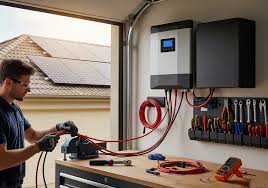
⚙️ How It Happens in Real Installations
Imagine you’re running a 5kW system with panels 20 meters from the charge controller. You use a 6mm² cable because it “worked fine” on a smaller setup.
Here’s the catch — at higher current loads, that cable now causes a 4–5% voltage drop. That means your 24V array is effectively delivering only 22.8V under full sun.
Multiply that by dozens of connections, and you’ve just robbed your system of hundreds of watt-hours every single day.
💡 The Fix: Proper Cable Sizing and Routing
The simplest way to eliminate this Solar Wiring Mistake is to size your cables based on current, voltage, and distance — not habit or guesswork.
Here’s what I do on every installation:
- Calculate voltage drop before buying cables. I aim for less than 2% total loss across the system.
- Use thicker cables for longer runs. If your array is far from your inverter, go up one or two sizes.
- Keep cable runs short and straight. Avoid unnecessary bends or loops.
- Crimp properly. Loose or corroded terminals increase resistance and heat, cutting efficiency further.
A little extra investment in the right wiring today can save you years of performance issues and warranty headaches later.

🧠 Pro Tip for Every Installer
Hello there! Are you a solar user, installer, or vendor — check out the Globisun Solar App.
It helps you:
- Size your solar energy system accurately (panels, batteries, charge controllers, and wiring specs)
- Get tailored weather forecasts to understand how sunlight conditions will affect your system
- Look up inverter or charge controller error codes — and see exactly how to fix them
- Join a marketplace to promote your business as an installer or vendor
Download it on the Play Store:
👉 https://play.google.com/store/apps/details?id=com.globalnet.globisun
🚀 Final Thoughts
Every solar professional wants to deliver systems that perform at their best. Yet, it’s often the small details — like wiring — that make or break overall efficiency.
By paying attention to cable size, length, and connection quality, you can eliminate the Solar Wiring Mistake that’s quietly draining your installations of precious power.
In solar work, precision isn’t optional — it’s profitability.