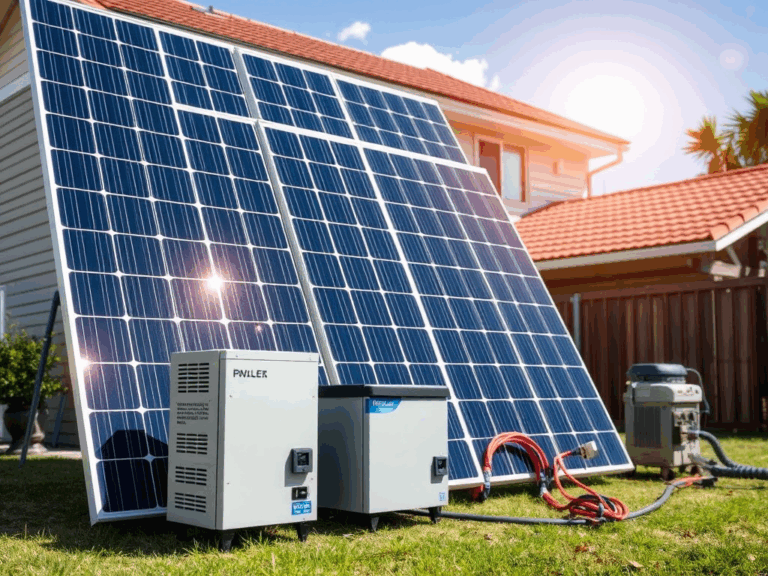
The Truth About ‘All-in-One’ Solar Systems Nobody Wants to Admit
Over the past few years, I’ve noticed something interesting in the solar industry — everyone suddenly wants an “all-in-one solar system.”
You’ve probably seen them too: a single sleek box that combines an inverter, charge controller, battery, and sometimes even Wi-Fi monitoring — all advertised as plug and play, maintenance-free, and smart.
Sounds amazing, right?
Well, it’s time we talk about the truth that nobody really wants to admit — especially to newcomers and unsuspecting customers.

Why All-in-One Solar Systems Became So Popular
Let’s start with the obvious: convenience sells.
All-in-one systems are marketed as the next big thing — simple to install, clean-looking, and beginner-friendly.
They promise to remove the “complexity” of traditional solar setups by putting everything in one box. For small residential systems or backup applications, this idea sounds perfect.
And honestly, I get it.
For homeowners who just want lights, fans, and a TV to stay on during power cuts, an all-in-one solar solution seems like a miracle.
For installers, they’re quick to set up — less wiring, fewer components, less time spent troubleshooting.
But the reality, as many professionals quietly know, is not that simple.
The Hidden Trade-Offs
Here’s where things get tricky.
When you combine multiple functions — inverter, MPPT, battery management, AC charger — into one box, you also combine multiple points of failure.
If your inverter fails, you don’t just lose inversion — you often lose charging and battery management too.
If the internal MPPT burns out, you can’t simply swap it; you have to replace the entire unit.
And unlike modular systems, most all-in-one units are not designed for easy repair or upgrade.
So when one part goes bad, the whole system suffers.
That’s like having a car where the engine, gearbox, and wheels are fused together — convenient to drive, but a nightmare to fix.
Performance Limitations They Don’t Tell You About
Many all-in-one solar systems are optimized for cost, not performance.
Here’s what I’ve found in the field:
- Limited MPPT range: They often struggle to harvest efficiently in low sunlight or partial shading conditions.
- Restricted expansion: You can’t easily add more panels or batteries later.
- Cooling issues: Everything packed in one unit means more heat, and more heat means shorter lifespan.
- Smaller surge handling: They handle appliance start-up surges poorly compared to stand-alone inverter systems.
On paper, they look great. In real life, they sometimes underperform — especially when users try to power loads beyond their actual design.
The Illusion of “Smart Features”
I’ve seen so many all-in-one systems advertised with features like “AI Smart Power Management” or “Auto Load Balancing.”
Let’s be honest — most of that is just marketing language.
What these features really mean is that the system prioritizes certain loads when battery power runs low or grid power cuts in. That’s not AI — that’s just basic load logic programming.
The problem is, people see the word “smart” and assume the system can handle anything. Then it fails, and they blame the installer.
Who All-in-One Systems Are Actually Good For
Now, don’t get me wrong — I’m not against all-in-one systems.
They have their place, and when used correctly, they can be fantastic.
They’re ideal for:
✅ Small residential setups — where power needs are predictable and light.
✅ Portable or backup systems — where simplicity is more important than scalability.
✅ Budget-limited clients — who need a quick, functional solution, not long-term expandability.
If you’re transparent about what the system can and cannot do, all-in-one units can serve clients well.
The real issue is when they’re sold as “one-size-fits-all” solutions — which they are not.
The Misleading Marketing Problem
Manufacturers rarely talk about these limitations because, well, it doesn’t sell.
They’ll show you sleek designs, impressive labels, and exaggerated capacity ratings.
But they won’t tell you how the system struggles with high heat, limited ventilation, or overloading.
They don’t tell you that a “5kVA all-in-one” might actually perform closer to 3.5kVA in real conditions — or that it can’t handle continuous heavy loads.
And when something goes wrong, who do clients call? The installer.
What I Tell My Clients Now
These days, I make it a rule to educate clients before recommending any all-in-one system.
I tell them, “It’s a great compact solution — but if you ever plan to expand, or if you have sensitive appliances, you’re better off with a modular setup.”
Sometimes they still choose the all-in-one for convenience — and that’s fine, as long as expectations are clear.
As professionals, we have a duty to guide, not just sell.
Because when that system fails in six months, it’s your name they remember, not the manufacturer’s.
Final Thoughts
The truth about all-in-one solar systems is this: they’re brilliant for the right purpose but dangerous when oversold.
They’ve made solar more accessible, but they’ve also made too many people believe solar is “plug and play.”
As the industry grows, I hope more manufacturers — and even influencers — start being honest about what these systems can and can’t do.
Until then, we as professionals must keep telling the truth, one installation at a time.
Have you installed or used an all-in-one system before?
I’d love to hear your real-world experience — what worked and what didn’t.
Join the discussion inside the Globisun Solar App:
👉 Open the App