Solar Sizing for Small Shops: Panels, Battery Capacity & Charge Controller Guide
Running a small shop on solar is one of the smartest investments you can make—zero noise, zero fuel, stable power, and predictable running costs. But the biggest challenge for most shop owners is knowing the right panel size, battery capacity, and charge controller rating.
This guide breaks it down into simple, practical steps, with examples you can follow for any small business: boutiques, salons, mini-marts, betting shops, phone shops, POS stands, and more.
Section 1 — Identify Your Shop’s Electrical Load
The first step of solar sizing is listing everything you want to power.
Common loads in a small shop include:
- LED bulbs (5–20W each)
- Standing/ceiling fan (45–75W)
- Charging phones (10W each)
- TV (40–90W)
- Decoder (10–20W)
- Laptop (50–70W)
- Printer or POS (small 10W to large 150W)
- Small freezer (90–150W running, 500–800W start)
- CCTV cameras (8–15W)
Example Load List for a Small Shop
| Appliance | Qty | Watts | Total |
|---|---|---|---|
| LED bulbs | 4 | 10W | 40W |
| Standing fan | 1 | 60W | 60W |
| TV | 1 | 60W | 60W |
| Decoder | 1 | 15W | 15W |
| Phone charging | 3 | 10W | 30W |
Total running load = 205W
Round up for safety: 250W
For a small shop with a freezer, use:
250W + freezer (150W running) = 400W running load
Round up: 450–500W
Section 2 — Solar Panel Size Needed
To calculate panel size, use this formula:
Panel Size (W) = Daily Energy (Wh) ÷ Peak Sun Hours
Where:
Daily Energy (Wh) = Total Load (W) × Hours of Operation
Assume 6 hours grid-off operation (evening or cloudy periods).
Example A — Shop Without Freezer (250W load)
Daily Energy = 250W × 6 hours = 1,500Wh
Assume 25% system losses → 1,500 ÷ 0.75 = 2,000Wh
Peak Sun Hours = 5 hours
Required Panels = 2,000 ÷ 5 = 400W solar panels
Recommended: 450W to 550W panels (10–20% extra recommended)
Example B — Shop With Freezer (450W load)
Daily Energy = 450W × 6 hours = 2,700Wh
Adjusted for losses → 2,700 ÷ 0.75 = 3,600Wh
Required panels = 3,600 ÷ 5 = 720W
Recommended: 800W to 1,000W panels
(Example: 2 × 550W = 1,100W)
Section 3 — Battery Capacity Needed
Formula:
Battery Capacity (Wh) = Total Load (W) × Hours of Backup
Then convert Wh → Ah:
Battery Ah = Wh ÷ System Voltage (usually 12V or 24V)
Example A — No Freezer Shop (250W load)
Backup time needed: 6 hours
Battery Wh = 250 × 6 = 1,500Wh
For a 12V system:
Battery Ah = 1,500 ÷ 12 = 125Ah
Use lithium → 12V 150Ah LiFePO4 recommended
For a 24V system:
Battery Ah = 1,500 ÷ 24 = 62.5Ah
Use lithium → 24V 100Ah LiFePO4
Example B — Shop With Freezer (450W load)
Backup needed = 6 hours
Battery Wh = 450 × 6 = 2,700Wh
For a 24V system:
Battery Ah = 2,700 ÷ 24 = 112.5Ah
Use 24V 150Ah LiFePO4
For 12V system (not recommended for freezers):
Ah = 2,700 ÷ 12 = 225Ah
Would require large batteries—better use 24V.
Section 4 — Charge Controller Size Needed
Formula:
Controller Current = Total Panel Wattage ÷ Battery Voltage
Add 25% safety margin.
Example A — 500W solar on 24V
500 ÷ 24 = 20.8A
20.8 × 1.25 = 26A
Recommended: 30A MPPT
Example B — 1000W solar on 24V
1,000 ÷ 24 = 41.6A
41.6 × 1.25 = 52A
Recommended: 60A MPPT
Section 5 — Complete Recommended Solar Setups
Below are tested & trusted setups for small businesses.
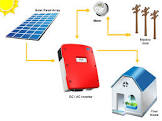
Option 1: Small Shop Without Freezer
Perfect for boutiques, POS, salons (light loads)
- 550W solar panel (1 piece) or 350–430W × 2 panels
- 12V 150Ah lithium battery
- 1kVA inverter
- 30A MPPT charge controller
- DC breakers, fuses, cables
- Proper earthing
Backup: 6–10 hours
Running load: 200–300W
Option 2: Shop With Freezer
For mini-marts, cold drink shops, food stores
- 1,100W solar panels (550W × 2)
- 24V 150–200Ah lithium battery
- 1.5kVA–2kVA inverter
- 60A MPPT
- Breakers, fuses, wiring
Backup: 6–8 hours
Running load: 400–600W
Section 6 — Tips to Avoid Solar Failure in Small Shops
- Use lithium batteries (longer life, deeper discharge).
- Use MPPT, not PWM controllers.
- Never connect freezer & pressing iron to small systems.
- Oversize panels by 20–40% during dry season (panels lose efficiency in heat).
- Clean panels every 10–14 days.
- Keep inverter in a cool, ventilated area.
- Don’t mix batteries of different ages or brands.
Conclusion
Solar power is one of the best investments for small shops, but correct sizing is the key to enjoying stable power. With the formulas and examples above, you can calculate the exact size of:
- Solar panels
- Battery capacity
- Charge controller rating
- Inverter size