Bifacial vs Monofacial Solar Panels: Which One Is Better for You?
Solar energy continues to change how we power our homes and businesses. One key decision stands out: choosing between bifacial and monofacial solar panels.
Both technologies convert sunlight into electricity. However, they differ in design, efficiency, and energy yield. Understanding these differences can help you make the best choice for your solar investment.
In this guide, we’ll break down the differences between bifacial and monofacial solar panels. We will explore their pros and cons. You can use the Globisun app to determine which panel fits your solar system sizing and energy needs perfectly.
What Are Monofacial Solar Panels?
Monofacial solar panels are the traditional type of panels most people are familiar with.
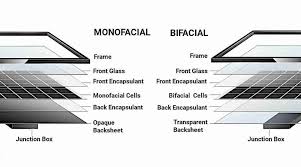
They have solar cells on one side — the front — which captures sunlight and converts it into electricity.
The back side is usually covered with an opaque sheet, so only the front surface is active.

✅ Advantages of Monofacial Panels
- Affordable: They’re cheaper to produce and install.
- Widely available: Compatible with most rooftop installations.
- Lightweight: Easier to handle and mount on smaller roofs.
- Proven technology: Reliable and well-tested over decades.
⚠️ Disadvantages
- Limited light absorption: Only the front side absorbs sunlight.
- Lower energy yield: They perform less efficiently in diffused or reflected light conditions.
🌤 What Are Bifacial Solar Panels?
Bifacial solar panels are an advanced type of module. They capture sunlight from both sides. This includes the front and the back.
The front side absorbs direct sunlight, while the back side captures light reflected from the ground or nearby surfaces. This dual capture mechanism allows for higher energy generation, especially in bright, reflective environments (like sandy or snowy areas).

✅ Advantages of Bifacial Panels
- ⚡ Higher efficiency: Can produce 10–30% more energy than monofacial panels.
- 🌍 Better performance in diffuse light: Great for cloudy conditions.
- 🧱 Durability: Often built with glass on both sides, making them more robust.
- ♻️ Lower Levelized Cost of Energy (LCOE): More energy production over time reduces cost per watt.
⚠️ Disadvantages
- 💰 Higher initial cost: More expensive to manufacture and install.
- 🏗️ Installation complexity: Requires elevated mounting to capture reflected light effectively.
- 📏 Requires careful system sizing: To maximize performance, accurate solar system sizing and placement are essential.
⚡ Bifacial vs Monofacial: Key Differences at a Glance
| Feature | Monofacial Panels | Bifacial Panels |
|---|---|---|
| Light absorption | Front side only | Front and back sides |
| Energy yield | Standard output | 10–30% higher output |
| Durability | Single glass layer | Double glass or transparent backsheet |
| Cost | Lower | Higher |
| Weight | Lighter | Slightly heavier |
| Best suited for | Rooftop setups | Ground-mounted or commercial systems |
🌅 Which Is Right for You?
The answer depends on your installation type, budget, and energy goals.
- If you’re installing on a residential rooftop with limited space, monofacial panels may be the practical choice.
- If you want maximum energy efficiency, consider bifacial panels. These panels are especially beneficial if you plan a ground-mounted or commercial installation. Bifacial panels can deliver better long-term returns.
No matter which you choose, proper solar system sizing is essential for efficiency, longevity, and cost savings.
📱 Make the Right Choice with the Globisun App
Manually comparing panel types and calculating your energy needs can be overwhelming. That’s where the Globisun mobile app comes in.
Globisun is your smart guide to solar energy. It is built to simplify everything about solar power. This includes system sizing to real-time monitoring.
With the Globisun app, you can:
- 🔢 Calculate your solar system size instantly — know how many panels, batteries, and inverters you need.
- ☀️ Compare energy performance of monofacial vs bifacial panels.
- ⚙️ Check inverter error codes and get troubleshooting help.
- 🧭 Find nearby solar service centers and product dealers.
- 🌦️ Access live weather data to plan your installation more accurately.
Whether you’re a homeowner, technician, or solar business owner, Globisun helps you make smarter solar decisions with precision and confidence.
👉 Download Globisun on Play Store to get started.
💡 How the Type of Panel Affects Solar System Sizing
When using bifacial panels, your system may require:
- Fewer panels to meet your energy needs.
- Different mounting angles or structures for optimal rear-side reflection.
Monofacial panels, on the other hand, might need:
- More panels for the same output.
- Closer placement without worrying about rear light reflection.
To ensure your setup is efficient and balanced, use the Globisun app. Perform an accurate solar sizing based on your energy load, roof area, and daily sunlight hours.
🌍 Real-World Example
Let’s say your daily energy need is 4,000Wh/day.
Using monofacial panels, you might need 10 panels of 400W each.
With bifacial panels (25% higher yield), you’d need only 8 panels of 400W to achieve the same result.
You can simulate this easily in the Globisun solar calculator for quick, precise results.
💬 Frequently Asked Questions (FAQ)
1. What is the main difference between bifacial and monofacial solar panels?
Bifacial panels capture sunlight from both sides, while monofacial panels only use one side. This gives bifacial panels a higher energy yield.
2. Are bifacial solar panels worth it?
Yes — if installed correctly, bifacial panels can increase energy generation by 10–30% in reflective environments. This improvement gives you better returns in the long term.
3. Which is more cost-effective for residential solar systems?
Monofacial panels are generally more budget-friendly for home installations. However, bifacial panels can be more efficient for commercial or large-scale systems.
4. How can I calculate my solar system size accurately?
Use the Globisun app to automatically calculate your solar sizing, based on your load, location, and available sunlight hours.
5. Can I mix bifacial and monofacial panels in one system?
It’s not recommended, as their electrical and physical characteristics differ. Always consult a solar professional — or use the Globisun app to design a compatible system.
☀️ Final Thoughts
Both bifacial and monofacial solar panels have unique benefits.
If you want affordability and simplicity, go for monofacial panels.
If you prefer efficiency, durability, and advanced performance, bifacial panels are the future.
Whichever you choose, make sure your system is properly sized. It should be optimized for your energy needs. Use the Globisun mobile app to achieve this.
👉 Download Globisun on Play Store today. Take control of your energy future. Make one smart solar decision at a time. 🌞